


Have you ever looked at a Polymarket market and thought: why is there always someone willing to buy at 48 and sell at 52?
That’s inherent to a trader’s strategy. And increasingly, it’s paid.
Polymarket has a liquidity program called ‘Rewards’ that pays traders for doing the unsexy but essential job of keeping markets tradable. These traders post competitive limit orders on the book to help narrow the spread and create healthier market dynamics. It is speculated, yet unconfirmed, that people who participate in the rewards program will qualify for the Polymarket token airdrop. We don’t know for sure, but it’s good to know how the program works all the same.
Polymarket is dropping millions and millions of dollars for their rewards programs. So in this post we will cover:
What Polymarket Rewards are
How do you earn rewards
Why rewards matter
Why whales (aka top traders) care
How to use Stand’s Pegged Orders to optimize after them
What are Polymarket Rewards?
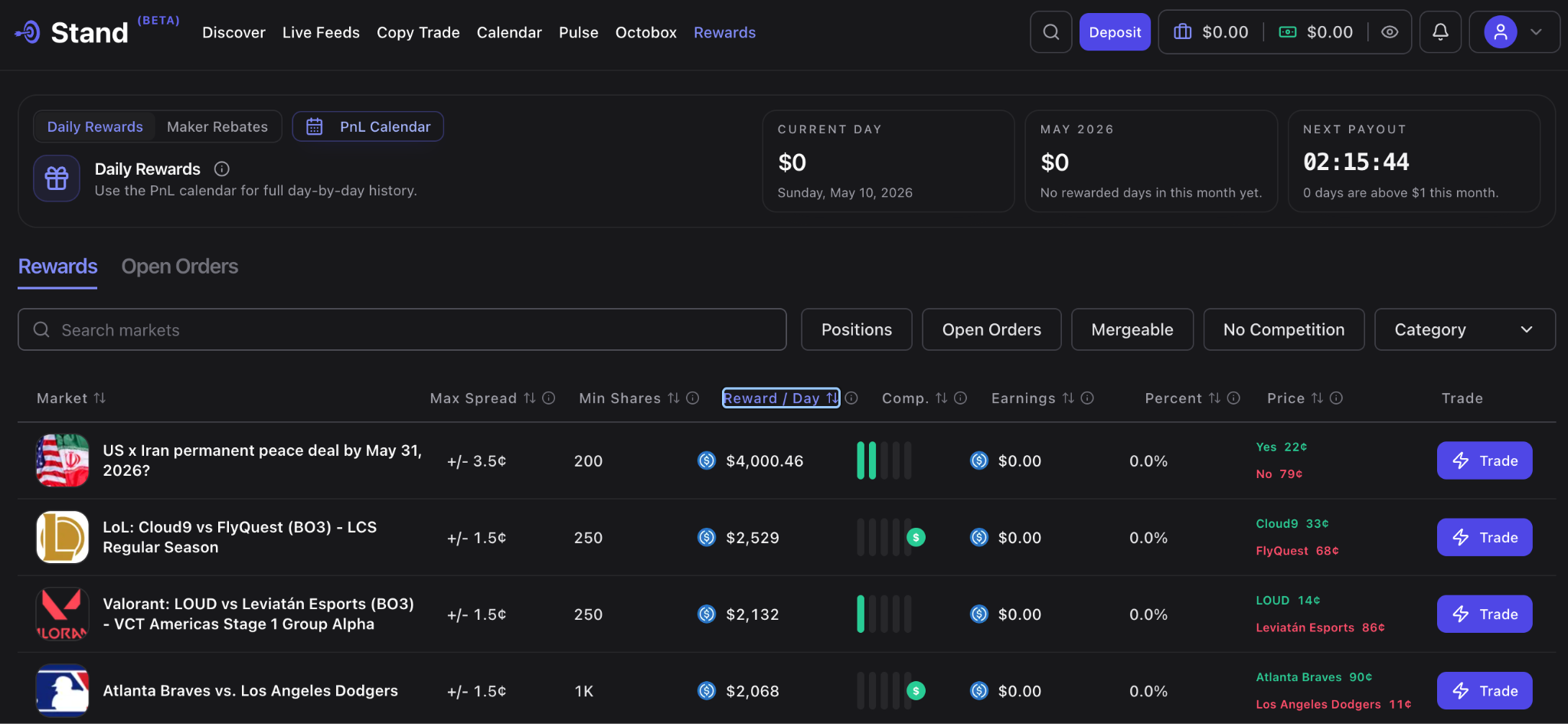
Polymarket Rewards are daily payouts from Polymarket for traders who provide liquidity by placing resting limit orders (maker orders).
To simplify the terminology even further,
A market order is you showing up hungry and ordering whatever’s ready. You don’t care about the price.
A limit order is you putting your name on the list and saying, “I’ll only buy at this price” or “I’ll sell at that price.”
When your limit order sits on the book, it helps other traders get filled at better prices. That makes the market healthier, so Polymarket incentivizes it.
You may notice we used a term called “maker orders” above. Maker orders are any order that helps add liquidity to a market. Taker orders are any order that removes liquidity from a market. Polymarket does not incentivize for this.
It’s important to remember that rewards are for makers (people posting resting orders or adding liquidity to a market), not takers. Rewards are distributed daily at midnight UTC. Polymarket will drop the amount of rewards earned directly into your wallet.
Polymarket designed the program to encourage tight, competitive quotes near the midpoint and generally discourage overtly exploitative behavior. You don’t need to memorize the formula, although it’s available in Polymarket’s documentation. The intuitive version is:
The more you help keep the market tradeable, by quoting reasonable prices with real size, consistently, the more you can earn.
How do you earn Polymarket rewards?
After you have found a market you want to earn rewards in, you need to check the rewards’ criteria for that market.
Each market will have their own spread, own reward, and minimum shares amount to qualify.
Take the ‘Maine Senate Election Winner’ market. To qualify for rewards here, you need to place a limit order (maker order) of at least 200 shares within $0.035 cents of the market price.
If I placed a maker order of 100 shares, I would not qualify.
If I placed a maker order outside the $0.19-$0.23 reward spread range, I would not qualify.
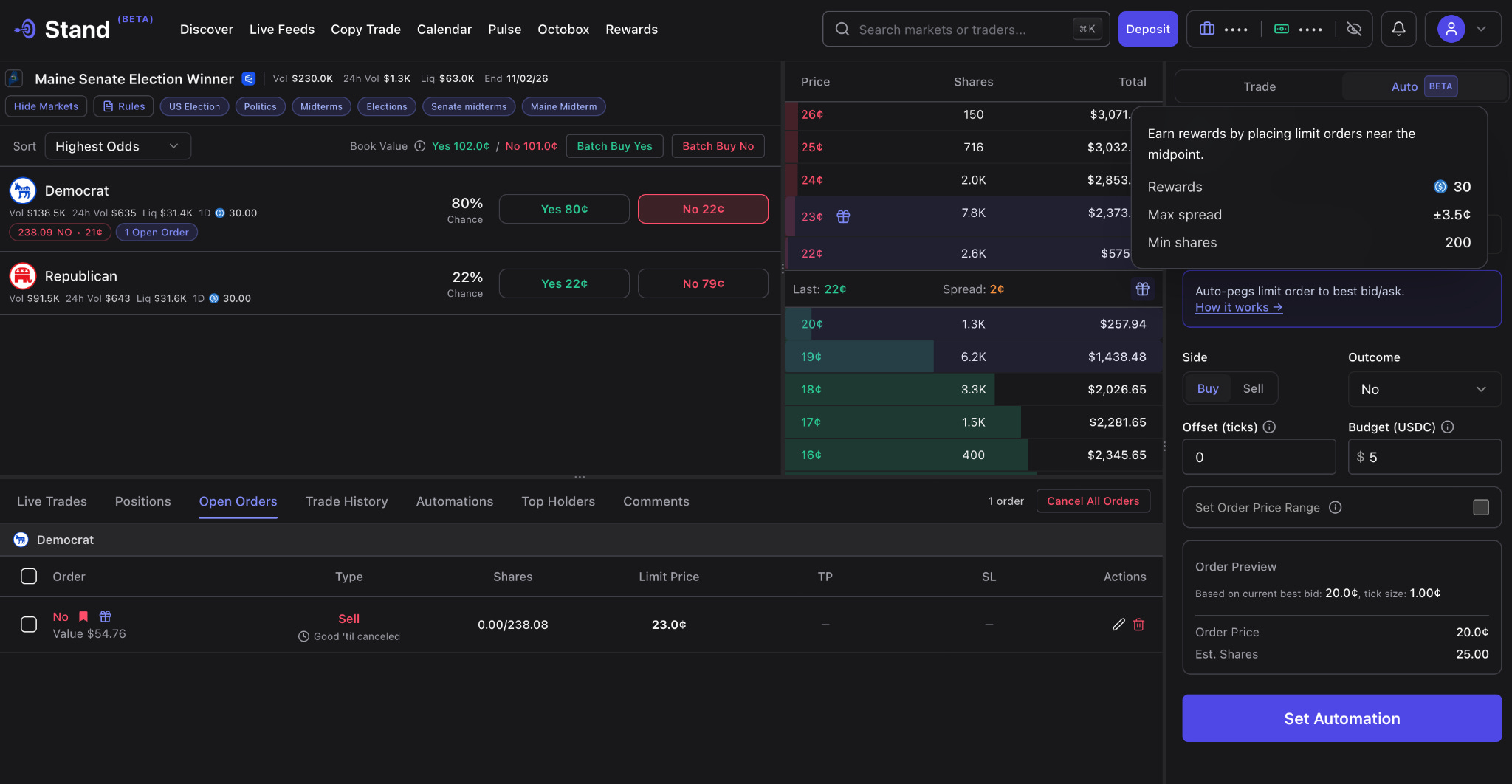
Stand highlights the price band you need to place your maker order to qualify for rewards. When you place a maker order, a gift icon for your order will appear indicating that you are earning rewards.
If your order gets filled, you will no longer qualify. Active positions do not qualify for the rewards programs, only orders do.
The $30 for this market will be distributed to all qualifying participants. Some markets are more competitive than others, making it difficult to earn rewards. Polymarket gives you a nice competition meter and scoring liquidity percentage to help you see where you stand in a market. The scoring liquidity percentage shows you how much liquidity you are providing to that market.
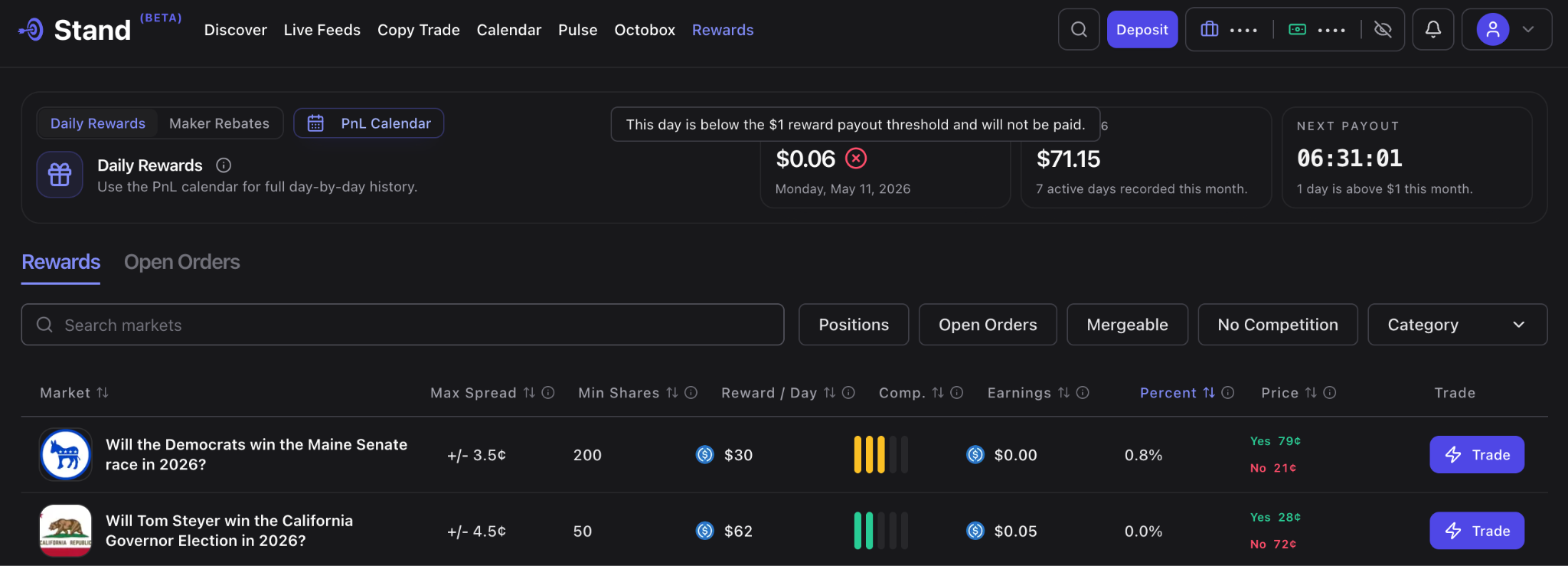
Rewards are paid out each day at midnight UTC. To earn the payout, you must pass the $1 reward payout threshold. Otherwise, you will not be paid.
This is why it’s important to look at the competition and choose your markets accordingly!
Why do Polymarket Rewards matter to the Polymarket ecosystem?
Because liquidity is the difference between “this is a cool idea” and “this is a real market.”
More liquidity means, tighter spreads (cheaper to trade), more depth (you can trade without moving price as much), better price discovery (prices reflect information faster), and more trust (markets feel less like a casino, more like a venue)!
From time to time, Polymarket will ramp up incentive programs to spark certain market categories. Be sure to be on watch, but remember, whales are also watching and have a larger bank roll than you!
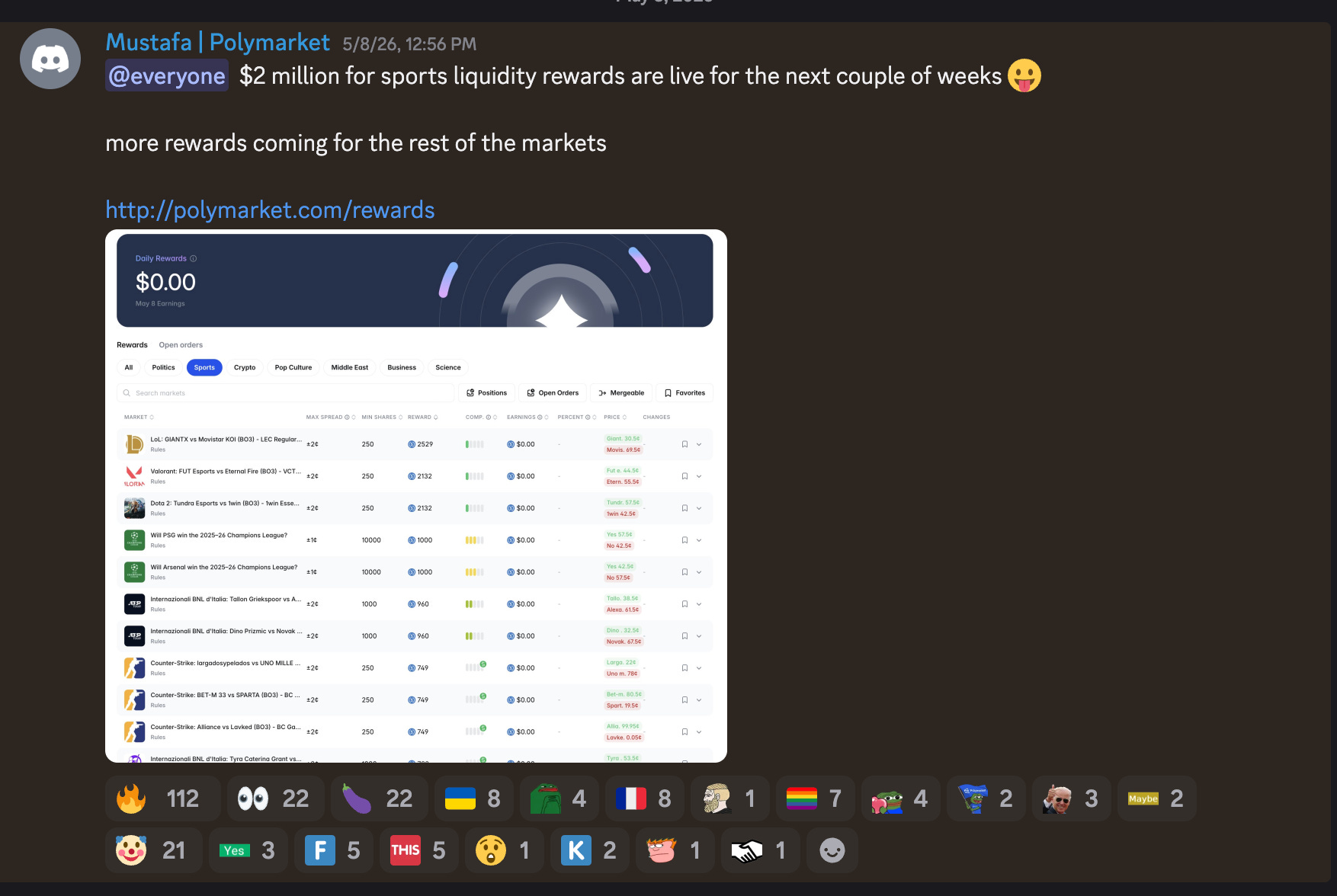
Why does Polymarket do this? In their own words,
Catalyze liquidity across all markets
Encourage liquidity throughout a market’s entire lifecycle
Motivate passive, balanced quoting tight to a market’s midpoint
Encourage trading activity
Discourage blatantly exploitative behaviors
Why do whales care about Polymarket Rewards?
Say you’re a whale trading size, the spread isn’t a rounding error – it’s your rent. Rewards can “rebate” your execution costs too. If you’re the one tightening spreads (posting competitive bids/asks), rewards can offset the cost of showing liquidity and getting filled.
Whales focus on Polymarket Rewards for two reasons:
It helps them with market discovery
It’s another source of income
Whales want to know which markets are new and which are healthy. Best case scenario is you find a market you understand well, can price it accordingly, and get paid in rewards in the process. That’s why whales look at rewards. Some traders are amazing in sports markets, but get wrecked in political markets (or vice versa). Rewards allow the pros to stay in their lanes and get paid in the process.
And rewards scale with process. The best traders don’t just have opinions – they have systems. Whales are consistently in markets, consistently near the right price, and consistently managing risk. The rewards pay consistency. That’s whale-friendly. Rewards also have the added benefit of being category-specific. You can filter them to a field of your expertise. And voila! Another source of income for trading how you want.
Thankfully, Stand automates pegged orders to level the playing field and help traders of all sizes farm rewards!
How do Stand’s Pegged Orders help with rewards?
Stand’s mission is to make traders profitable. Early on we spotted rewards favors people who are consistently quoting competitive limit orders. Most humans are not built for “consistently”.
So Stand built pegged orders to help traders farm Polymarket Rewards
NOTE: Pegged orders work in Stand accounts, not imported/linked Polymarket accounts.
What is a Pegged Order?
A Pegged Order is an automated limit order that automatically adjusts based on a rule, so your order can stay “near the action” instead of becoming stale the moment the market moves.
Instead of placing a limit order and then watching the market move, forcing you to cancel/replace your orders until your soul leaves your body, pegged orders automate the keep-your-quote-competitive loop.
Here is a simple, sane “rewards” farming playbook:
1. Pick a market you’d be fine holding.
The Rewards icon will appear in the order book telling you how much and what you need to do to qualify. Remember! Rewards are not free money. You can get filled. Choose markets where “oops, I got filled” isn’t catastrophic, ideally in a topic you understand well.
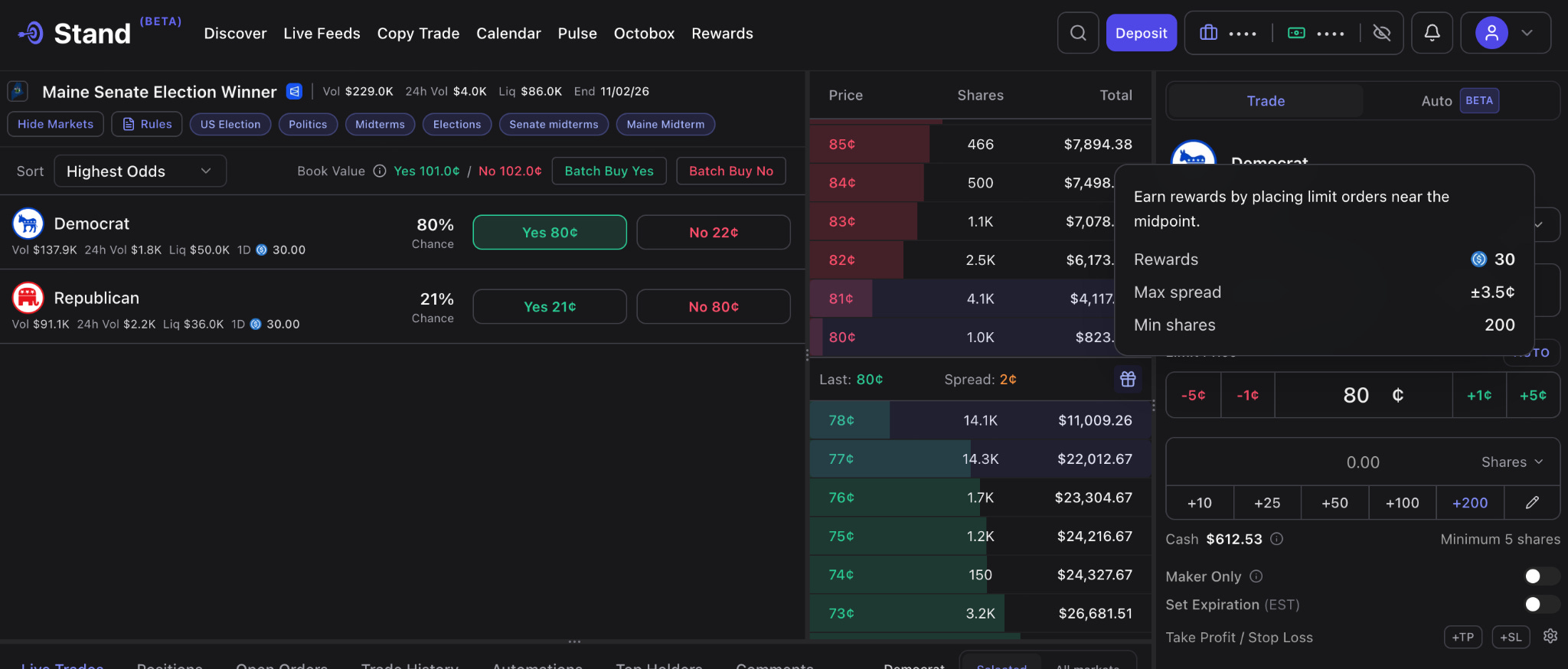
2. Go to the Auto tab of the Trade Panel. Use Top-of-Book pegged orders to stay competitive
3. Pick the side and the outcome you want for a specific market.
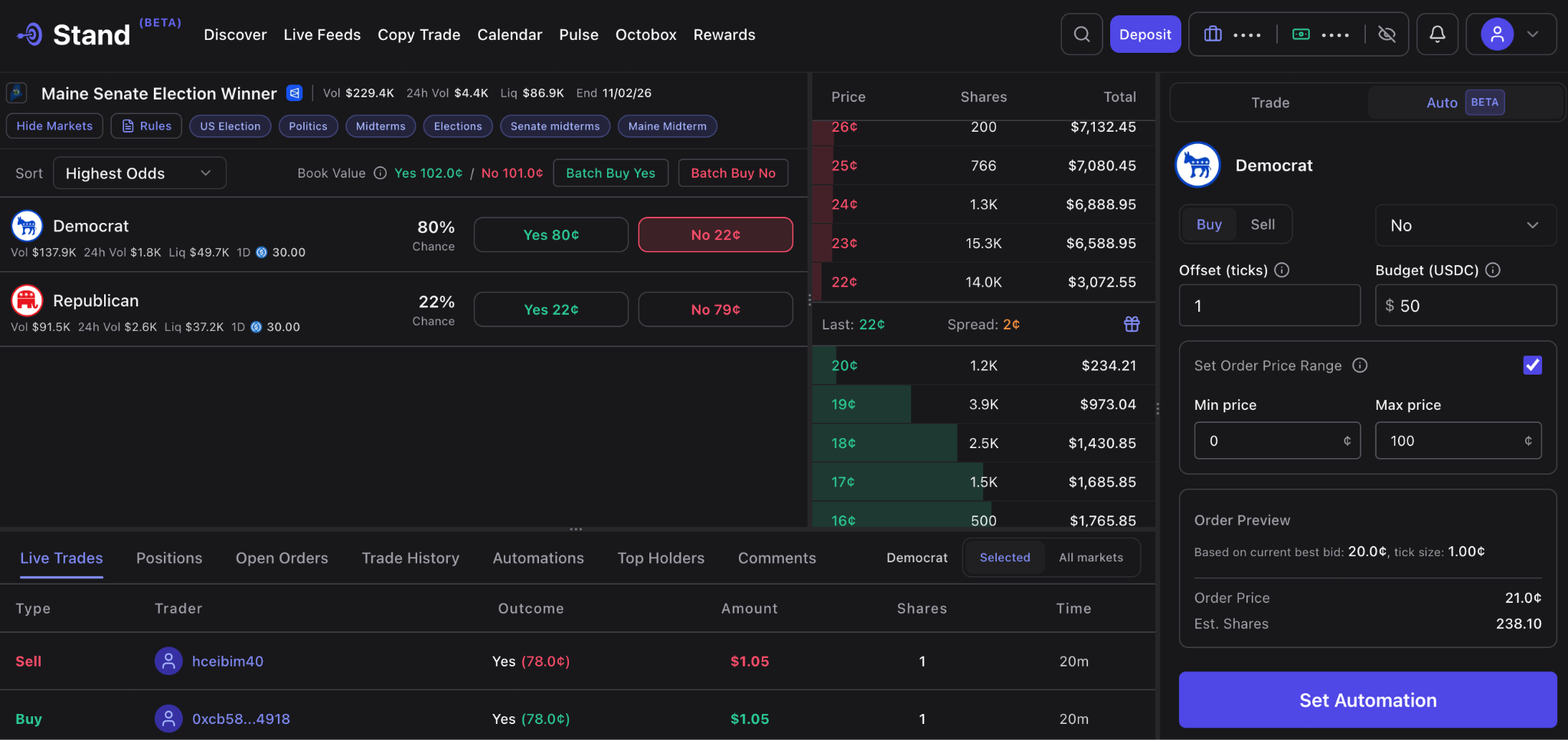
4. Select your offset and budget.
The offset is how far from the best bid/ask your order will be kept. For example,
A tick of ‘0’ = Keeps you at the top of the order book
A tick of ‘+1’ = 1 ticks above the best bid/ask
A tick of ‘−1’ = 1 ticks below the best bid/ask
In the market I’ve selected, I need at least 200 shares to qualify for rewards. A $50 budget is the lowest amount I can place for the automation.
It may be a good idea to choose an order price range, that way the automation will stop if the order book moves outside your range. It’s one more control at your disposal.
5. Click ‘Set Automation’ and voila! You’re now earning rewards.
You can see the automation in the order book with the robot icon. When you hover over it, it will tell you what the settings are and if you qualify for rewards.
You can see your automations at any time in either the market page or your profile. Go to “Automations”. You can turn it on or off there.
NOTE: Every Stand trader gets 5 pegged order automations. Use them wisely!
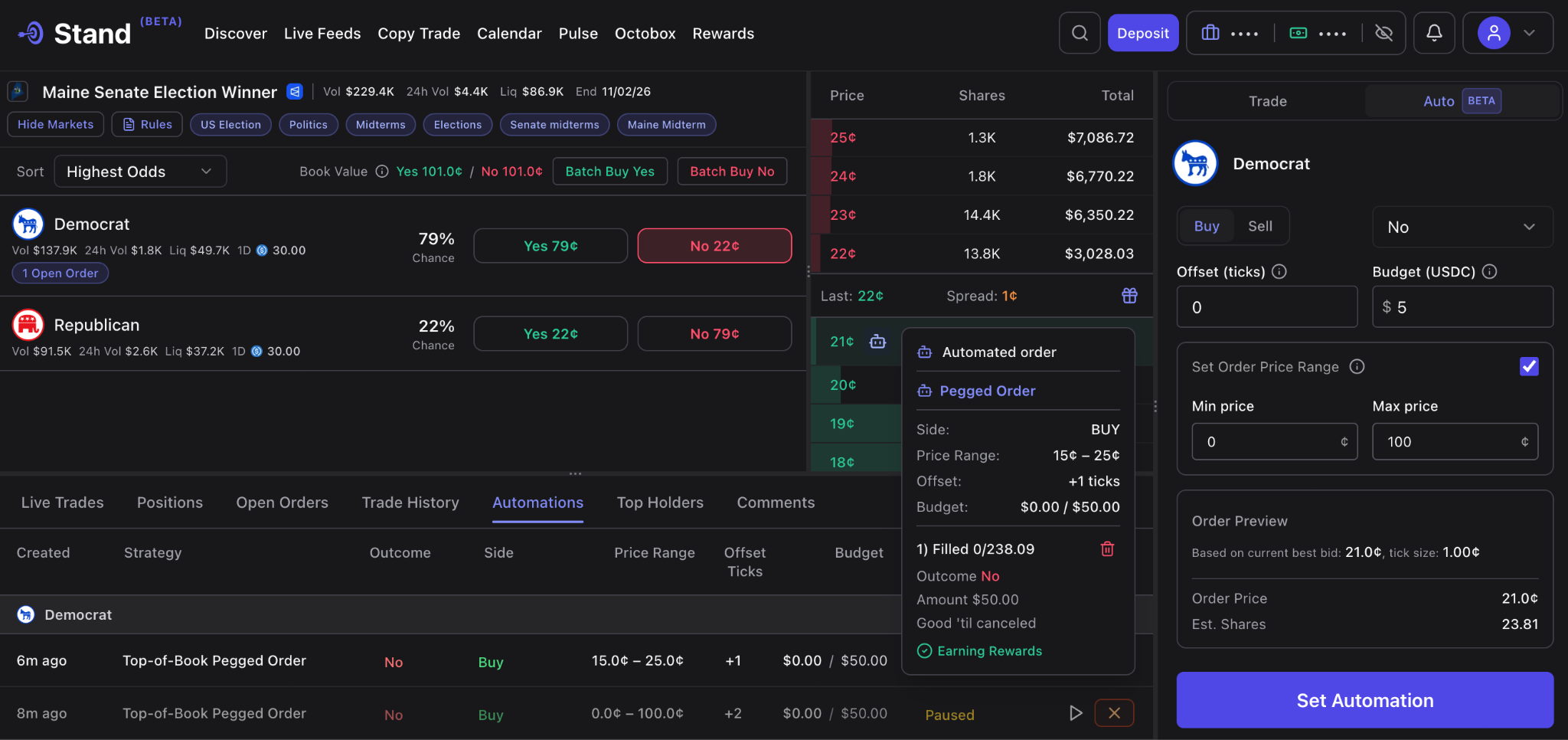
6. Monitor like a grown-up
Stand’s Pegged Order automation is powerful, but it’s not a babysitter. If the market conditions change (ex: news, volatility, liquidity dries up), you have to adjust. And if you set the offset too aggressively, you’ll lose more to adverse selection than you gain by earning rewards. Never confuse ‘farming’ with ‘printing’. The point is a positive net outcome. Stand’s alerts will help, but ultimately, it’s up to you.
One key idea to remember is that Polymarket’s liquidity rewards methodology explicitly incentivizes tight, balanced quoting. So two-sided depth gets boosted and single-sided can still score in many cases. Translation: if you can provide useful liquidity without getting run over, you’re playing the game Polymarket is paying for.
In Closing
If you want to earn Polymarket Rewards, you’re not trying to be “right” in the headline sense, you’re trying to be useful to the order book consistently.
Stand makes that easier by allowing traders
see markets fast
trade quickly
automate execution with tools like Pegged Orders
and (if you want) copy trade whales while you learn the ropes
We have more automations coming. Tell us what you want and what you think of the rewards article in the comments! Take a Stand. Earn when you’re right.
N.B: This content is provided for informational and educational purposes only and should not be construed as financial or investment advice.