

In light of the MicroStrategy market – yikes! – we figured it was a good time to walk through how Polymarket markets get resolved. If you’ve ever traded on Polymarket, there’s one scary moment you don’t think about until it matters, “Who decides what ‘actually happened’?”. But first, we have to start at the beginning (where else would we start?).
How Are Polymarket Markets Created?
Before you can understand resolution, you need to understand how markets are built because the construction determines everything that comes after.
Every market starts with a question. Something like:
Will the Federal Reserve increase interest rates by 50+ bps in June?
Who will win the World Cup?
Will the US and Iran sign a permanent peace deal by July?
The more specific, the better. Each market has two sides: a “Yes” side and a “No” side. Traders buy shares of either outcome. That binary structure is what makes settlement possible: when the event concludes, one side wins and one side loses.
But beyond having a good idea for a market, whoever creates it has to write the rules that govern the outcome. That means selecting a resolution source (an oracle or data source that acts as the barometer for truth), defining an end date, and spelling out edge cases. What happens if the event is postponed? What if the data source goes offline? What counts as a “yes”?
The four-step flow looks something like this:
1. Have an idea for a market
2. Write the rules, including which resolution source will be used to verify the outcome and set an end date
3. Judge whether the rules were met after the event
4. Pay out the winners
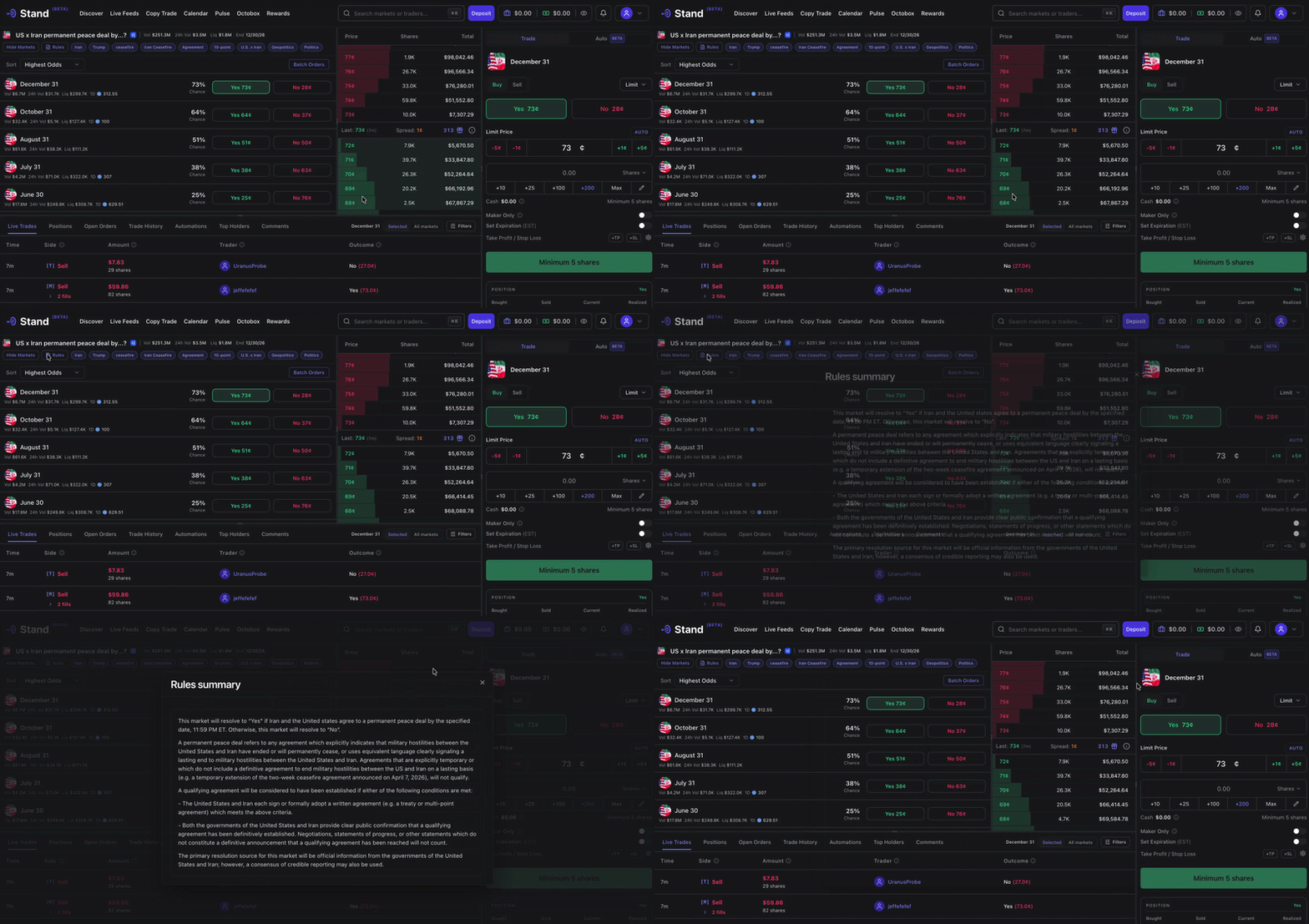
Simple in theory. Brutal in practice. Market construction is everything. If the rules are ambiguous or the resolution source fails to deliver, the whole thing breaks down. You can always review the rules and end date on any Stand market page before you put money in.
Different exchanges handle this differently. Kalshi, for example, submits every set of market rules to the CFTC under their Designated Contract Market license, and their in-house team finalizes results when criteria are met. Their process is far more opaque in how they adjudicate the actual resolution. Polymarket takes a different approach, an approach that leans on a decentralized protocol to handle the adjudication. That protocol is called UMA.
What Is UMA?
UMA is an “optimistic oracle”. It is a crypto protocol designed to verify truth on-chain. Think of it as the referee that Polymarket calls in when a market needs to be settled. You can read the full technical overview in UMA’s documentation.
The key word is optimistic. UMA doesn’t verify every single answer upfront. Instead, it assumes that proposed answers are correct unless someone challenges them. This makes the system fast and cheap under normal conditions, while still having a robust dispute mechanism for when things get contentious.
Here’s the analogy: imagine Wikipedia, but with a financial bounty attached. Anyone can write an entry (propose an outcome). If nobody challenges it within a set window, it becomes truth. But if someone believes the entry is wrong and is willing to put money on it, they can challenge it. Then a community of voters steps in to adjudicate.
That’s how UMA’s Optimistic Oracle works.
One important thing to internalize: UMA is not a news outlet or a fact-checking service. It’s an incentive and dispute system. It doesn’t have editors or journalists deciding outcomes. It has economic incentives that make honesty profitable and dishonesty expensive.
How Polymarket Resolution Actually Works
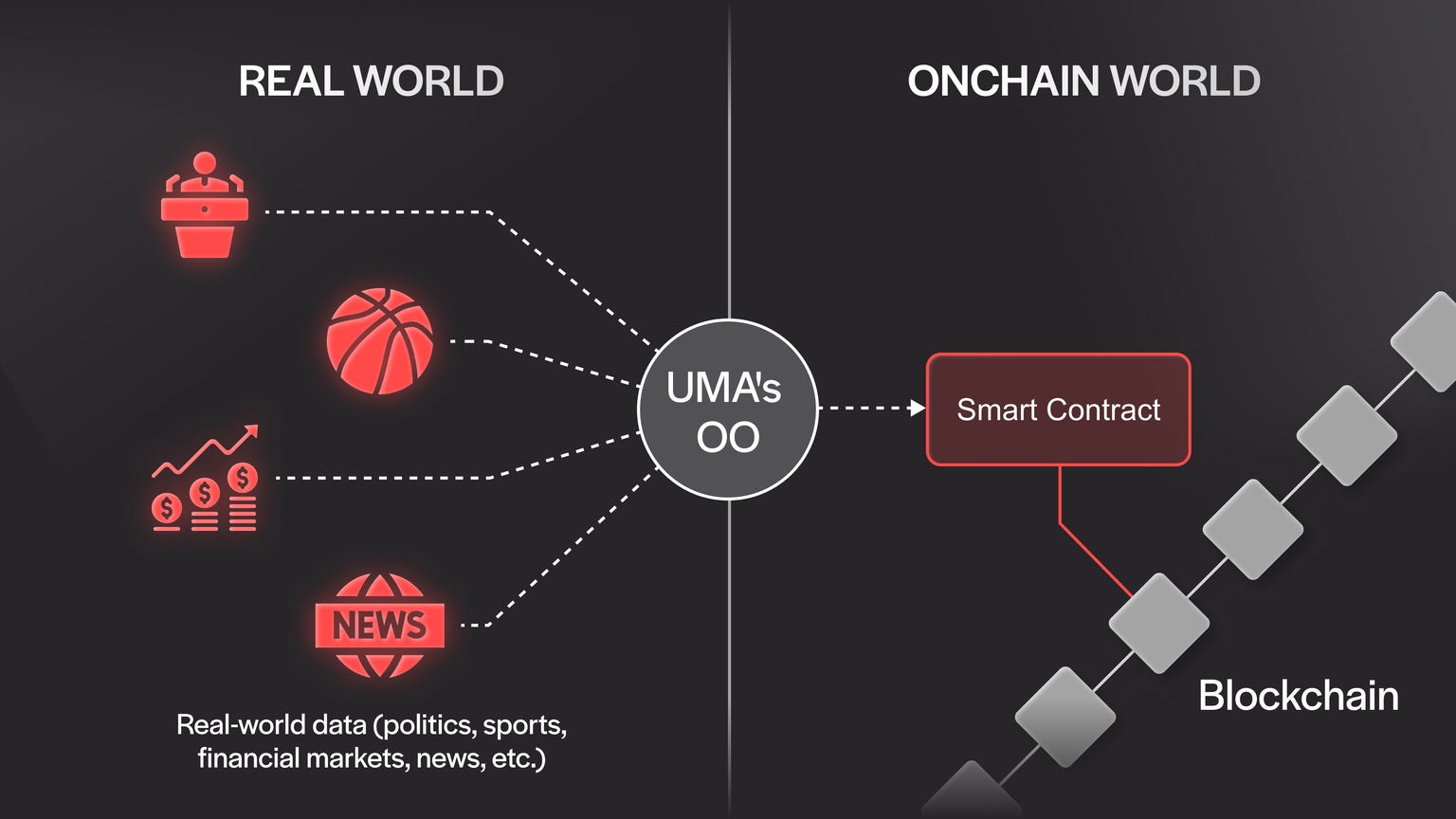
Polymarket documents their full resolution rules here. Here’s how the process flows, step by step.
Phase 1: The Proposal
Presumably after a market’s end date passes and the real-world event has concluded, anyone – and we mean anyone, not just traders – can propose the winning outcome.
To do so, the proposer posts a bond of approximately $750 in pUSD (Polymarket’s collateral token). That bond is the skin-in-the-game mechanism to maintain good behavior. If the proposal is correct and goes unchallenged, the proposer gets their bond back plus a reward for steering the market to its natural conclusion. If they propose incorrectly, or propose too early before the event is truly over, they lose the entire bond.
The bond theoretically keeps bad-faith or premature proposals from clogging the system. You can see how to submit a proposal through UMA’s proposing walkthrough. UMA’s greatest strength is also its greatest weakness: it relies on human nature.
Phase 2: The Challenge Window
Once a proposal is submitted, there’s a 2-hour window where anyone can dispute it. During this time, trading can still happen as the market hasn’t officially closed.
If nobody disputes within those two hours, the proposal is accepted and the market resolves. Fast, clean, done. This is the most common outcome.
Phase 3: The Dispute
If someone believes the proposed outcome is wrong, they post a counter-bond, typically the same amount (around $750), and formally challenge the proposal. This triggers a new proposal round. If that second proposal is also disputed, the resolution escalates to UMA’s full arbitration mechanism, or the Data Verification Mechanism (DVM).
Disputes are not free. That’s the point. Only someone confident enough to risk $750 will raise one – which filters out noise. You can read how disputes work in UMA’s disputing walkthrough.
During the dispute’s 24–48 hour debate period, evidence can be submitted directly in UMA’s Discord channels (#evidence-rationale and #voting-discussion). This is where the actual back-and-forth about what “really happened” takes place.
Phase 4: The Vote
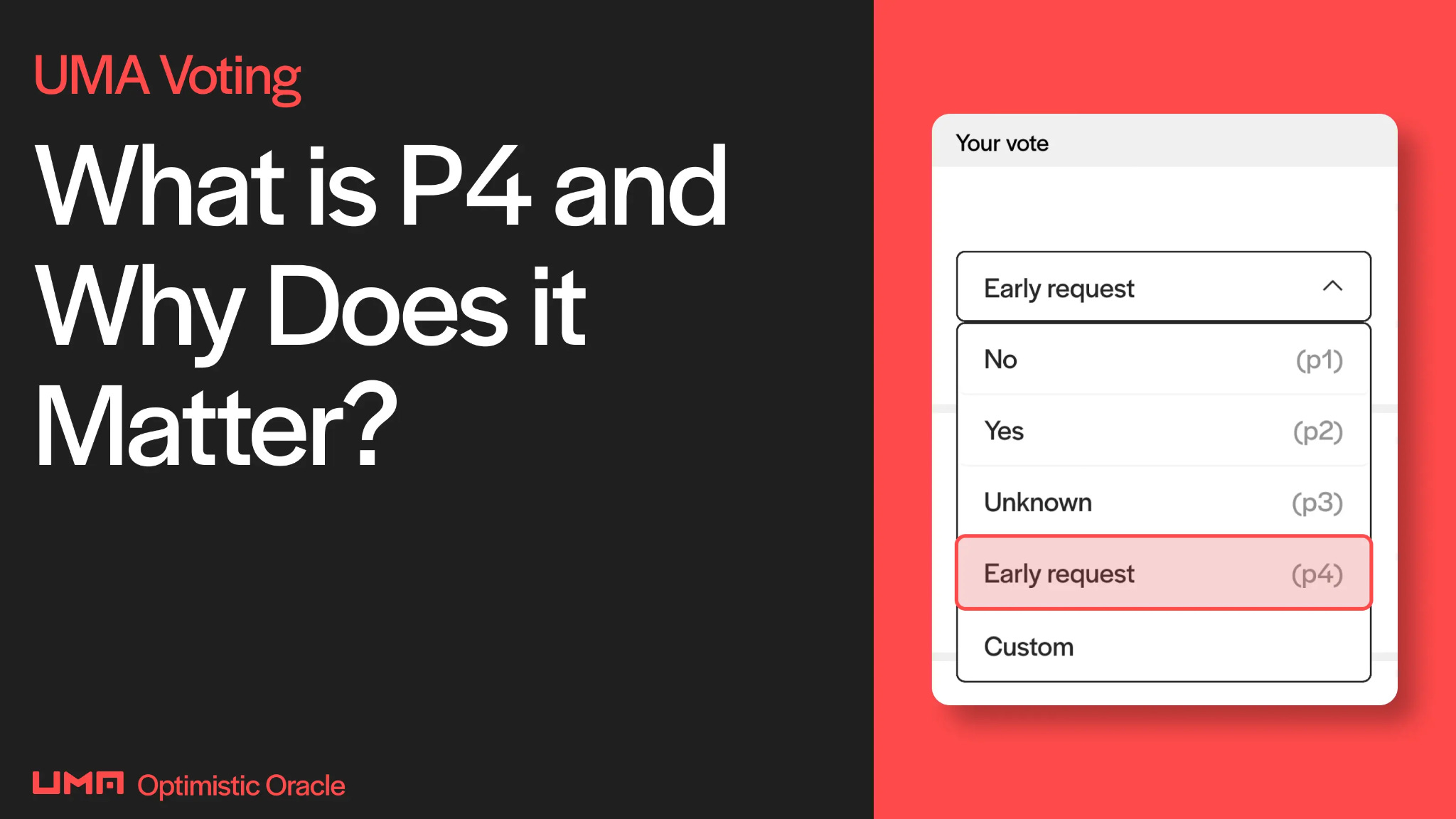
If the dispute escalates to the DVM, UMA token holders vote on the correct outcome. The voting process takes approximately 48 hours. There are four voting positions:
p1 - No, the event did not happen.
p2 - Yes, the event happened
p3 - The outcome is “unknown” or “cannot be determined”
p4 - “Too early” to decide based on the end date and rules
The bond outcomes depending on who wins are as follows. If the original proposer wins, they get their bond back plus half of the disputer’s bond. If the disputer wins, they get their bond back plus half of the proposer’s bond. In the special case of a “Too Early” ruling – meaning the event hasn’t actually concluded yet – the disputer wins the same way. And in the rare case of an “Unknown/50-50” ruling, the market resolves at $0.50 per share.
You can read the full dispute resolution lifecycle in UMA’s resolving disputes documentation.
Phase 5: The Resolution
Once a market resolves, whether through an unchallenged proposal or a DVM vote, trading stops, winning tokens become redeemable for $1.00 each, and losing tokens become worthless. If you’re on the winning side, you redeem through the CTF collateral adapter, which burns your outcome tokens and returns pUSD to your wallet.
There are Three Roles That Matter in UMA
The Proposer submits an answer to how the market should resolve. If they’re right and unchallenged, they profit. If they’re wrong and get disputed, they lose their bond. See UMA’s proposing overview.
The Disputer challenges an answer they believe is wrong. If they’re correct, as determined by UMA’s final arbitration they’re rewarded. If they’re wrong, they eat the cost. See UMA’s disputing overview.
The Arbitrator (UMA DVM) only enters the picture if a dispute is raised. UMA’s governance-based voting mechanism serves as the final judge and returns a ruling. See UMA’s dispute resolution overview.
So Who’s Actually the Judge: Polymarket or UMA?
Both, but for different things.
Polymarket defines the rules of the game on what counts as YES or NO, which sources matter, and how edge cases are handled. UMA enforces the adjudication mechanism: the optimistic proposal, the challenge window, and arbitration if it comes to that.
This separation is useful. Polymarket can focus on market design and user experience. UMA provides the hardened dispute infrastructure underneath. Neither has unchecked power over outcomes, which is the whole point. Ultimately, though, it’s not a marriage built to last.
Why is Polymarket leaving UMA? The UMA.Rocks Problem
Remember, everything above assumes UMA voters are acting in good faith. That assumption has been tested, badly, more than once.
In practice, the top ten wallet addresses account for more than half of all votes in disputed Polymarket markets. Making this worse is UMA.rocks, a platform that lets token holders pool and delegate voting power to a specialized committee which makes coordinated voting easier and more opaque.
The Wall Street Journal investigated this directly, finding at least 60% of active UMA voters held positions in the very markets they were voting to resolve across 300+ dispute cases. That’s not an edge case. That’s the norm. Garrick Wilhelm, a British Columbia resident who bet $567 against an Israel-Hezbollah ceasefire lost terribly as a result of UMA Rocks. He later learned his trade was decided by token holders who had their own money riding on the same outcome. The resolution itself was genuinely contentious. The criteria required confirmation from “both governments,” but Hezbollah isn’t a government. The IDF Chief said there was “no effective cessation of hostilities.” Hezbollah called the extension “meaningless.” The market resolved YES anyway on a secondary “overwhelming media consensus” clause the proposer invoked when the primary criterion was structurally unsatisfiable. Traders who read the literal rules lost. This ran alongside the $203M US-Iran ceasefire market resolving NO despite Trump publicly announcing an extension.
The reason why UMA fails is two-fold. First, the 2-hour challenge window is too short for most honest voters to vet real-world claims. Neglect becomes UMA.rocks ally. Second, a $750 bond is trivial relative to a seven-figure market. The risk/reward for a bad-faith dispute is almost always attractive. The people deciding “what really happened” are often the same people who bet on the answer, and a well-capitalized actor can override ground truth for a few thousand dollars. Show me the incentives and I’ll show you the outcome.
This is why Polymarket confirmed $POLY. Eventually, Polymarket will move off UMA in favor of its own resolution system that is community governed. The details are sparse, yet everyone is eagerly anticipating it. In the meantime, Polymarket has started issuing ‘clarifications’.
What Are “Clarifications” and Why Do They Matter?
In August 2025, Polymarket introduced a feature called clarifications. The name is exactly what it sounds like: edits or updates to how a market will be judged, issued after trading has already begun.
A clarification might add new resolution sources, for example, accepting credible news organizations in addition to official government statements. It might also expand upon how specific edge cases will be handled. Clarifications cannot change the fundamental intent of the original question, and they’re published on-chain via Polymarket’s bulletin board contract, making them auditable.
If you think a clarification is needed on a market you’re in, you can request one in the Polymarket Discord #market-review channel. You can also see clarifications happen on Stand.
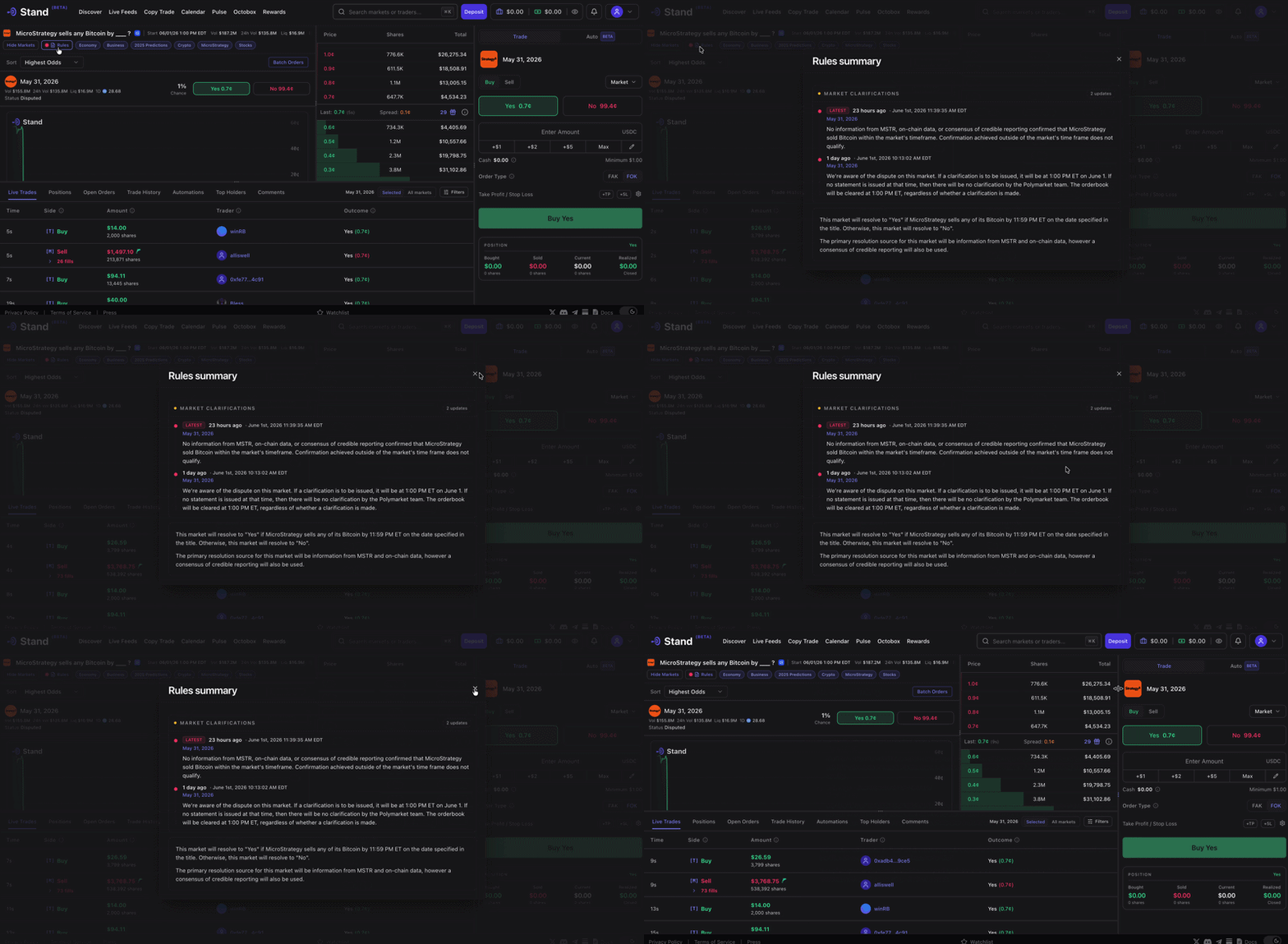
A pulsing red dot means a clarification was issued within the last 48 hours.
An amber dot means a clarification was issued more than 48 hours ago.
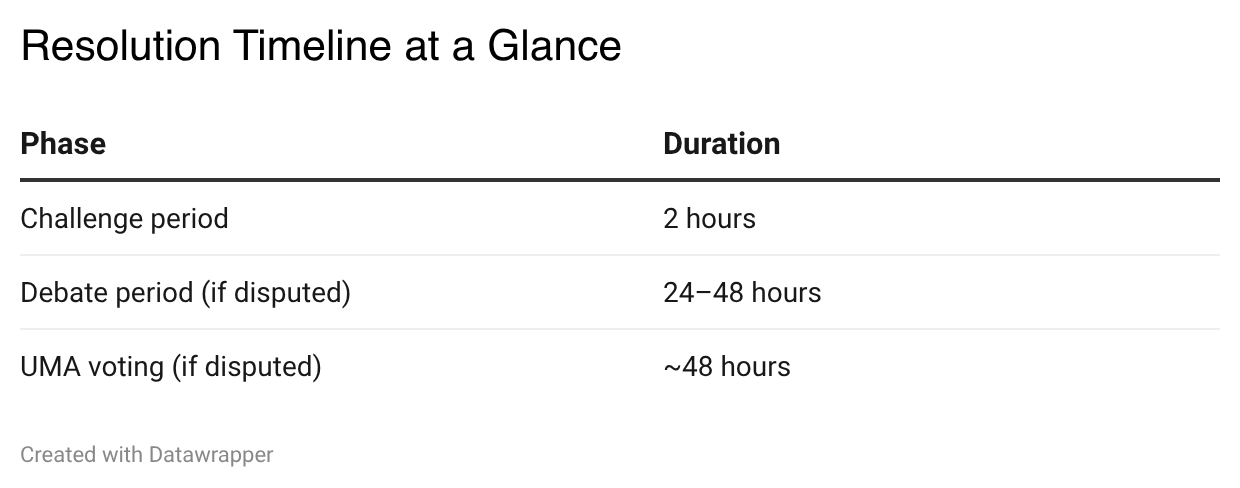
Undisputed resolution takes about 2 hours after proposal. A fully disputed resolution that goes to a DVM vote takes 4 to 6 days total.
Common Questions (FAQ)
What does “resolved” mean on Polymarket?
It means the market has a final outcome. The options are YES, NO, or 50/50. Winning positions can be redeemed for $1.00 each. See Polymarket’s resolution docs.
Can a resolved market change after the fact?
If a dispute is raised during the 2-hour challenge window and the final arbitration rules differently from the initial proposal, the outcome can change. That’s the whole point of the optimistic oracle plus dispute system. Learn more about it in the UMA dispute lifecycle and resolving disputes.
Why not just have Polymarket decide?
You could, but then you’re trusting one party to control the outcome of markets with real money on the line. The long-term play is the introduction of $POLY which we talk about in “In Closing”.
What should I do if I think a market will resolve controversially?
Read the resolution criteria before entering any trade. Most traders don’t take the time and that’s where they get burned. Avoid markets with vague language like “significant,” “major,” or “widely reported” unless you’re explicitly trading on that ambiguity. And treat “likely dispute” as a risk factor: disputes can add days to the resolution timeline and tie up your capital.
What happens to my money during a dispute?
Resolution affects when and whether you can redeem, and how long your capital is tied up. Disputes can extend timelines by 4 to 6 days. If you’re using Stand, this is one of those “quiet edges” where the traders who actually read the rules outperform the ones who don’t.
In Closing
Here’s the process again:
1. Market is created with rules: The market specifies what counts as truth: an official source, a specific metric, a timestamp cutoff. Ambiguity here is the number-one cause of resolution drama.
2. Event happens (or doesn’t): Trading continues until the market closes or becomes resolvable.
3. An outcome gets proposed on-chain: Someone posts a bond and submits “YES” or “NO” based on the market’s rules.
4. 2-hour challenge window: Anyone who believes the proposed outcome is wrong can dispute it by posting a matching bond.
5. No dispute → market finalizes: The proposed outcome becomes accepted truth. Winning tokens become redeemable.
6. Dispute → escalation to UMA arbitration: The DVM (governance-based voting) on Mainnet takes over. A 24–48 hour debate period, then a ~48-hour vote. Final ruling is binding.
P.S. What is $POLY and how does it factor into Polymarket’s resolution?
In April 2026, Polymarket announced what it called its “biggest change to date“ when it rebuilt its exchange stack, revealed a native stablecoin (pUSD, backed 1:1 by Circle’s USDC), and confirmed plans for a native governance token called $POLY. No launch date was given around $POLY, although competing prediction market exchanges like Predict have listed odds of a $POLY launch before EOY at just 48%.
The exact role POLY will play in resolution hasn’t been spelled out publicly. What’s clear is Polymarket is building toward owning more of its own infrastructure. If $POLY follows the playbook of other governance tokens in the prediction market space, it could eventually give $POLY holders influence over how disputes are adjudicated replacing or supplementing UMA’s DVM with Polymarket’s own staking and voting mechanism.
That would be a full-circle moment: a platform that launched by outsourcing truth to a third-party oracle, gradually reclaiming control over what counts as truth on its own platform. And while it hasn’t been confirmed, it stands to reason that Polymarket will reward traders with high volumes and market making capabilities. Thankfully, Stand helps you achieve both quickly and efficiently.